
Introducing Mesh Commons: An Origin Story
On the last day of RSA this year - the day with no meetings, relaxed in jeans and a hoodie - I walked the show floor one last time. At the “outside lands” of the Moscone South Hall, I turned the corner and saw this:
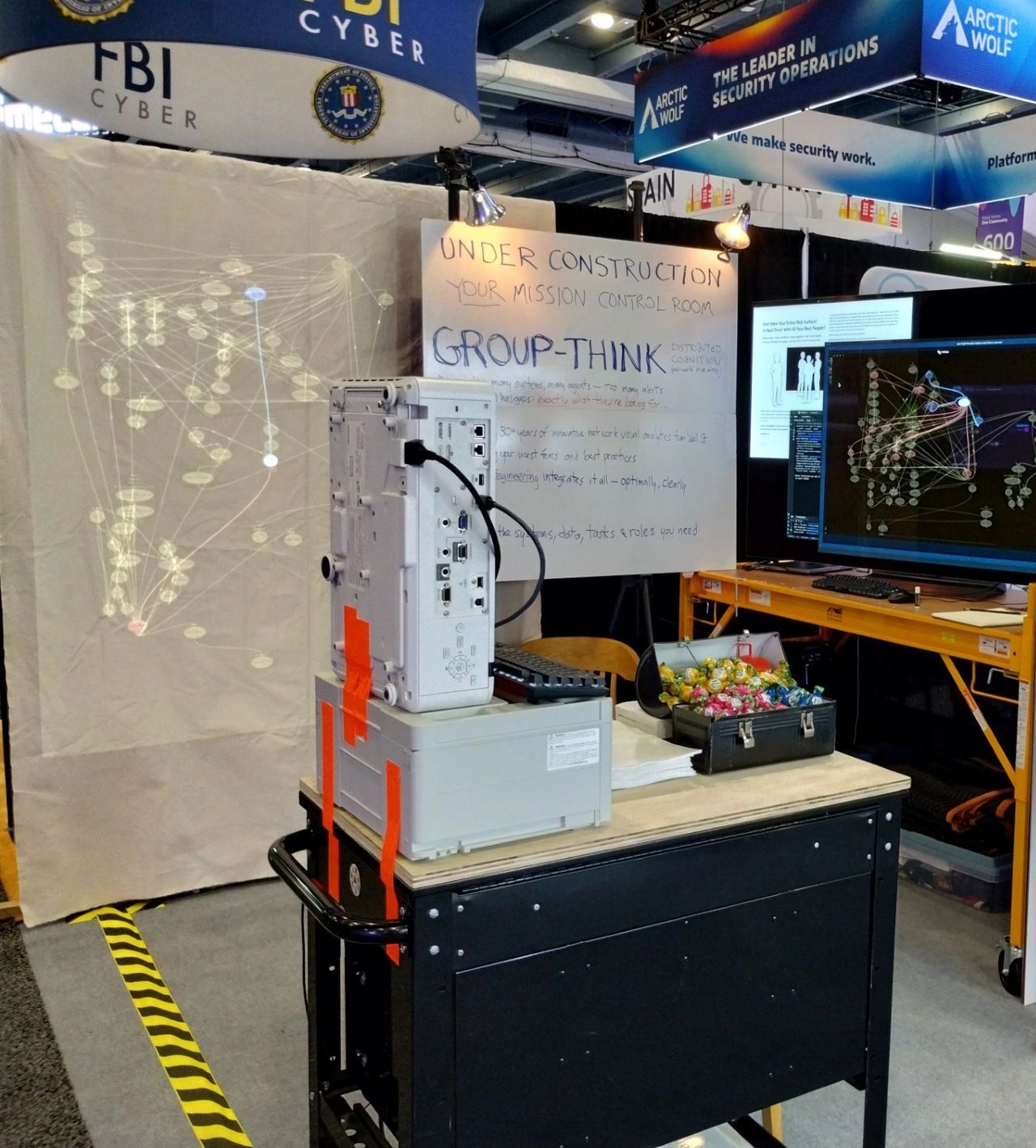
Simple, no nonsense workbenches, holding just the necessary tools to display technology, and the limitless possibility of a white board to convey a message:
Too many roles, too many systems, too much data - fragmented cognition creates the gaps attackers exploit. Cognitive Engineering unites them all into one shared view of reality.
It pulled me into a conversation with the key person at the booth: W. Bradford Paley, the pioneer behind the Cognitive Engineering Design Methodology (CEDM). Although new to cyber, he quickly realized that the complexity of our solutions had a "topological resemblance" to what he had been untangling for decades on Wall Street. There, he and his team, developed disruptive technologies for the New York Stock Exchange, Merrill Lynch and Franklin Templeton, to name a few.
Using CEDM, the applications compress complex, data into a single, cognitively optimized view. Unlike traditional dashboards that overload users or require them to switch screens to connect insights, Mesh Commons models each task step by step, displaying only the information required for the decision at hand.
This ensures 100% data utilization for every task, eliminates unnecessary data noise, and dramatically reduces time to act. In prior applications of this methodology - such as trading systems on Wall Street - decision time was reduced from minutes to seconds, demonstrating how CEDM enables faster comprehension, clearer collaboration, and more confident decisions under pressure.
Turns out, his work is fine art, too, seen around the world and displayed in the Museum of Modern Art in and in the permanent collection of the Whitney in New York City:

His question, and now mine:
What's the nature of complexity in today's cyber solutions - and where does it hinder the ability for executive teams to make smart, and quick decisions?
Over the next six months, I shared with him the many challenges the C-Suite faces when trying to make collective decisions. Together, we explored how CEDM could enhance cybersecurity decision-making across executive teams - aiming to achieve the same level of success it delivered on Wall Street.
To achieve this, we need to capture the valuable, yet fragmented insights of not just the CISO, but the entire C-Suite - and transform them into shared best practices, supported by real-time data that enables leaders not to speak past one another, but to think together through a shared cognitive lens.
We extended the conversation to our colleagues, CISOs and their teams, mapping out task sheets and resources for critical decision workflows like Incident Response Communications, Build/Buy/Partner, Security Budgeting and Supply Chain Risk Assessments. We soon realized that what we thought were ten or twenty executive cyber workflows were, in truth, hundreds.
We would need help...
The need for help became the spark for Mesh Commons. We founded it as a community-centered non-profit because the expert workflows should belong to the community.
Mesh Commons aims to bring order to this complexity - turning the workflows that live in people’s heads into operational systems that connect the many threads of cybersecurity decision-making too often trapped in silos. These workflows are numerous, intertwined, and frequently owned by no one - yet they mesh together to affect everyone.
Mesh Commons is a community that loves to engage. We do this through:
Member Workshops: Twice a month, we bring leaders and teams together to stress-test real-world decisions using Cognitive Engineering principles, co-developing open frameworks that enhance clarity, performance, and collaboration. Become a member.
Using CEDM, we redesign the tools your teams already use—turning complex interfaces and dense data into intuitive decision environments that cut through overload and drive confident action, from open-source security apps built on MISP to custom tools across finance, healthcare, and energy. Get Our Free Cognitive Assessment of Your Application.
Simulation Platform: An interactive environment for security consultant–led executive tabletop exercises, where leaders make decisions under realistic conditions - strengthening coordination, communication, and cognitive performance before crises arise.
To stay in touch, follow our Mesh Commons LinkedIn page where we will share:
- Mesh Commons Workflow Exchange: A monthly publication of member-nominated workflows selected for active development and community feedback.
- Visual Decision Frameworks: Structured models that capture how critical workflow decisions unfold — who decides, when, and with what information.
- Mesh Commons Research: We will be sharing research from our academic collaborators covering everything from innovations in AI enabled "flow state" to performance monitoring for neural optimization.
From a whiteboard at Moscone to a growing community of minds, the message remains simple: think better, together.